LYNX Python API Reference
Install golynx. Import lynx. Python 3.10 to 3.14.
1pip install golynxFifteen wheels: five interpreters across three platforms.
| Platform | Wheel tag | Install |
|---|---|---|
| Linux x86-64 | manylinux_2_34_x86_64 | pip install golynx |
| macOS Apple silicon | macosx_14_0_arm64 | pip install golynx |
| Windows x64 | win_amd64 | pip install golynx |
| Linux with CUDA | golynx-gpu | extra index |
| Jetson JetPack 6 | golynx-jp6-1 / -jp6-2 | extra index |
The GPU and Jetson builds are too large for PyPI and come from our own index:
1pip install golynx-gpu --extra-index-url <your beta index URL — provided at onboarding>Quick start
No catalog models are available yet. Bringing your own ONNX model is the only way to run the SDK today.
lynx.open("<slug>")appears throughout these pages and is the real API, but every catalog slug returnsmodel_not_in_productionuntil the catalog publishes — contact sales@synetic.ai for access.
Your own ONNX model:
1import lynx2 3with lynx.open_standard("your-model.onnx") as model:4 result = model.predict("street.jpg")5 6 for det in result:7 print(det.class_name, det.box.trust.confidence, det.depth.value)8 9 result.show()LYNX provides logic on top of trained models, so in order to separate measurements from the model and LYNX, measurements include their source.
The surface
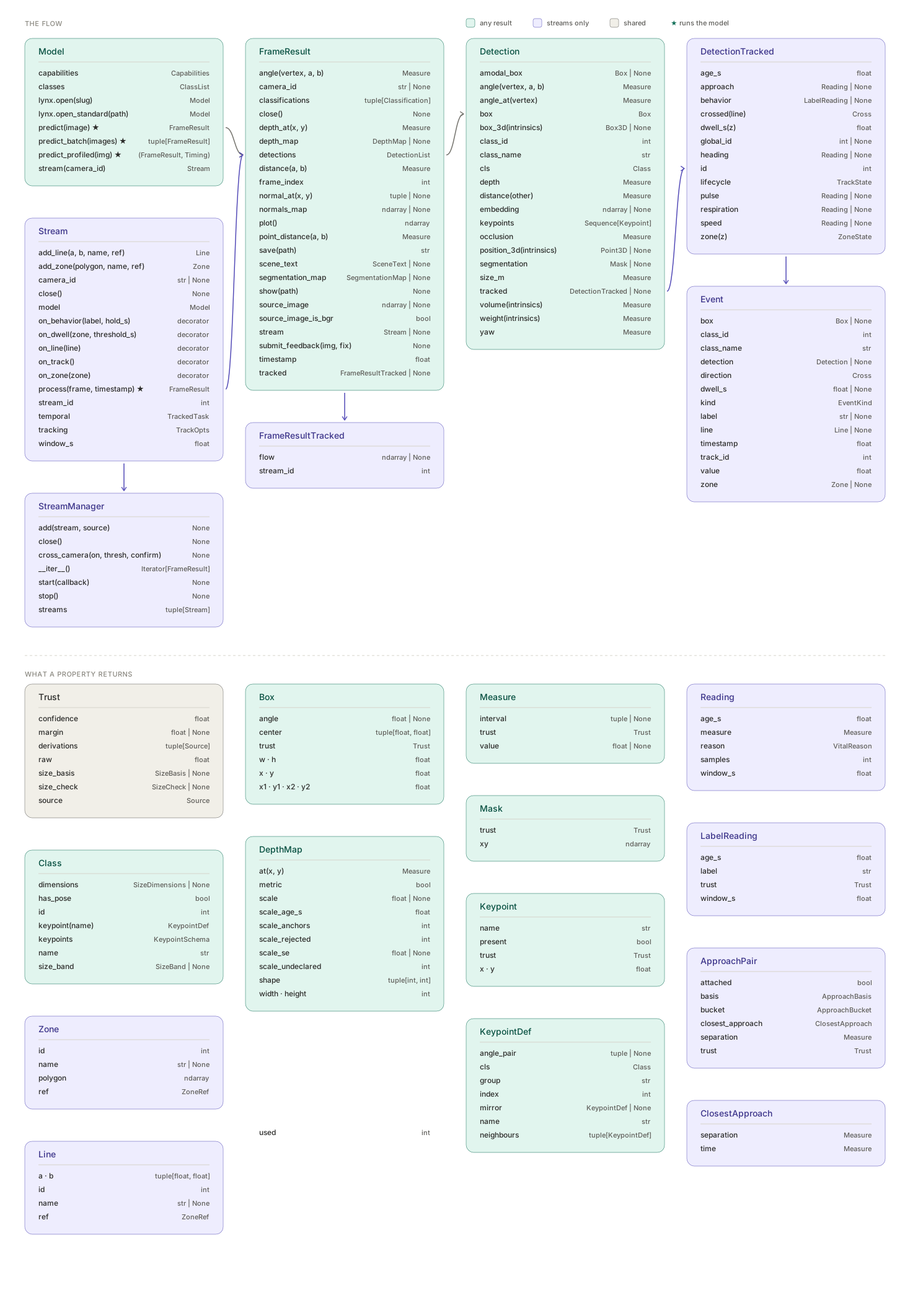
Model
Two ways in.
open
open() resolves a slug against the LYNX registry.
METHODopenclick to expand
open(slug="your-model-slug", *, version, tasks, confidence, goal, nms, seg_source, tiling, providers)Model
A LYNX model carries several heads. One pass returns detection together with whichever of segmentation, depth, pose, orientation, classification, text and re-identification that model was built with, without running the image again.
Each head beyond detection costs a few milliseconds, so by default only the
detection head runs. Enable the rest with tasks:
1model = lynx.open("your-model-slug", tasks=lynx.FrameTask.BOUNDING_BOX | lynx.FrameTask.DEPTH)Disabling a head you are not reading is the cheapest throughput you will find.
A model opened by slug downloads on first use and is cached. Later runs
re-download only if it changed. Pin version= to prevent that.
open_standard
open_standard() imports an ONNX model you already have.
METHODopen_standardclick to expand
open_standard(path, config=None, **opts)Model
Properties the file declares are used as they stand. Everything else is
deduced or declared through a Config. See Bring your own model.
An imported model ships no per class thresholds, so every class shares one.
Pass a calibration set to probe_config to produce them.
Members
1model = lynx.open("your-model-slug", tasks=lynx.FrameTask.BOUNDING_BOX | lynx.FrameTask.DEPTH)2 3print(model.slug, model.version, model.precision)4print(model.providers) # (Provider.TENSORRT,)5print(len(model.classes), "classes")6 7result = model.predict("street.jpg")8result, timing = model.predict_profiled("street.jpg")9print(timing.total_us)10 11model.close()available_batch_sizes
tuple[int, ...] — Batch sizes that already have an engine
build_id
str — Exact build, for reproducing a result
capabilities
Capabilities — Which heads this model has
classes
ClassList — The taxonomy it was trained on
METHODcloseclick to expand
close()None — Release the model and everything borrowed from it
license
LicenseInfo — Coverage and expiry
METHODpackageclick to expand
package(out, engines=None)None — Write model and config as one .lnxp
precision
str — Weight precision in use
METHODpredictclick to expand
predict(image, **opts)FrameResult — Run the model on one image
METHODpredict_batchclick to expand
predict_batch(images, **opts)tuple[FrameResult, ...] — Run it on several at once
METHODpredict_profiledclick to expand
predict_profiled(image, **opts)tuple[FrameResult, Timing] — predict plus stage timings
METHODprepareclick to expand
prepare(batch_sizes)None — Build engines now rather than on first use
providers
tuple[Provider, ...] — Runtimes it is executing on
slug
str — Registry name it was opened by
METHODstreamclick to expand
stream(camera_id=None, **opts)Stream — Build a stateful stream over this model
version
str — Catalogue version actually loaded
predict options
| Option | Type | Effect |
|---|---|---|
confidence | float or ConfidenceMode | Score floor, or a calibrated operating point |
max_det | int | Cap on returned detections |
tasks | FrameTask | Which heads to run. Detection only unless widened |
retain | Extent | Whether to keep modal or amodal extent |
nms | NmsMode | Override the model's declared NMS behaviour |
ocr | Ocr | Override text recognition |
channels | ChannelOrder | Override the input channel order |
seg_source | SegSource | Instance masks, dense map, or whichever the model has |
depth_gate | DepthGate | Reject detections whose metric size is implausible |
tiling | Tiling | Slice the frame and run each tile. Overrides the model's setting |
intrinsics | Intrinsics | Camera focal length and centre. Without it, distances come back relative |
timestamp | float | Stamp the result rather than using the wall clock |
stream options
| Option | Type | Effect |
|---|---|---|
temporal | TrackedTask | Which temporal heads to run |
window_s | float | Length of the temporal window |
queue | int | Depth of the input queue |
drop | DropPolicy | What to shed when the queue is full |
track_max_age_s | float | How long a track survives without a match |
track_min_hits | int | Matches before a track is confirmed |
scale_hold_s | float | How long a recovered depth scale stays valid |
weak_box_conf | float | Floor for boxes the tracker may continue a track with |
pulse | RateBand | Search bounds for the pulse estimator |
respiration | RateBand | Search bounds for the respiration estimator |
FrameResult
Iterating a FrameResult yields Detection. It is a Sequence[Detection], so
len(result) and result[0] work directly.
1result = model.predict("street.jpg")2 3print(len(result), "detections at", result.timestamp)4 5if result.depth_map:6 print(result.depth_at(640, 360).value, "m at centre")7 8a, b = result[0], result[1]9print(result.distance(a, b).value, "m apart")10 11result.save("annotated.jpg")12result.close()METHODangleclick to expand
angle(vertex, a, b)Measure — Degrees at vertex
camera_id
str \ — None — Label of the stream that produced it
classifications
tuple[Classification, ...] — Whole image labels
METHODcloseclick to expand
close()None — Release the frame
METHODdepth_atclick to expand
depth_at(x, y)Measure — Depth at one pixel
depth_map
DepthMap \ — None — Dense depth for the whole frame
detections
DetectionList — Everything found in the frame
METHODdistanceclick to expand
distance(a, b)Measure — Metres between two detections
frame_index
int — Position in the stream, 0 for predict
METHODnormal_atclick to expand
normal_at(x, y)tuple[float, float, float] \ — None — Surface normal at one pixel
normals_map
ndarray \ — None — Surface normals for the whole frame
METHODplotclick to expand
plot(...)ndarray — Detections drawn onto the frame
METHODpoint_distanceclick to expand
point_distance(a, b)Measure — Metres between two pixels
METHODsaveclick to expand
save(path=None)str — Write the plot, returns the path
scene_text
SceneText \ — None — Text read from the frame
segmentation_map
SegmentationMap \ — None — Dense per pixel class labels
METHODshowclick to expand
show(path=None)None — Open the plot in a viewer
source_image
ndarray \ — None — The frame as it went in
source_image_is_bgr
bool — Channel order of source_image
stream
Stream \ — None — The stream, when there was one
METHODsubmit_feedbackclick to expand
submit_feedback(image, correction)None — Report a wrong result
timestamp
float — When the frame was taken
tracked
FrameResultTracked \ — None — Frame level tracking state
distance takes two Detection. point_distance takes two (x, y) pairs.
DetectionList
Sequence[Detection]. Indexable, sliceable, iterable, len().
FrameResultTracked
None unless a stream produced the result. Everything here needs more than one
frame, which is why it lives on the tracked result rather than on FrameResult.
flow
ndarray \ — None
stream_id
int
Detection
1person = model.classes["person"]2nose = person.keypoints["nose"] if person.has_pose else None3 4for det in model.predict("street.jpg"):5 print(det.class_name, det.box.trust.confidence)6 7 if det.depth.value:8 print(" ", det.depth.value, "m,", det.size_m.value, "m tall")9 10 kp = det.keypoints[nose] if nose and det.class_name == "person" else None11 if kp:12 print(" nose at", kp.x)A detection names its class but does not hand you the class object: reach it
through model.classes. Keypoints index by KeypointDef, never by a raw
integer, so a model upgrade that reorders the schema cannot silently move
them.
amodal_box
Box \ — None — Full extent including the occluded part
METHODangleclick to expand
angle(vertex, a, b)Measure — Degrees at vertex, between rays to a and b
METHODangle_atclick to expand
angle_at(vertex)Measure — Degrees at a keypoint's declared pair
box
Box — Where it is, and how trusted
METHODbox_3dclick to expand
box_3d(intrinsics)Box3D \ — None — Its 3D extent in camera space
class_id
int — Numeric class, matches Class.id
class_name
str — Human readable class
cls
Class — The full class definition
depth
Measure — Metres from the camera
METHODdistanceclick to expand
distance(other)Measure — Metres to another detection
embedding
ndarray \ — None — Identity vector for matching across cameras
keypoints
Sequence[Keypoint] — Pose points, in schema order
occlusion
Measure — How much of it is hidden
METHODposition_3dclick to expand
position_3d(intrinsics)Point3D \ — None — Where it is in camera space
segmentation
Mask \ — None — Its outline, not just its box
size_m
Measure — Metric extent of the object
tracked
DetectionTracked \ — None — Identity and history, streams only
METHODvolumeclick to expand
volume(intrinsics)Measure — Cubic metres, needs camera intrinsics
METHODweightclick to expand
weight(intrinsics)Measure — Kilograms, from volume and class density
yaw
Measure — Degrees of rotation about the vertical
angle takes three KeypointDef, vertex first, matching
FrameResult.angle. angle_at takes one and uses the angle_pair declared on it.
box.angle is the oriented-box heading and is a different quantity from both.
depth is metres from the camera. size_m is the object's metric extent, also
metres. yaw is degrees. Read depth.trust.source to know whether the distance
rests on a measured focal length or an assumed one.
DetectionTracked
None when the detection matched no track. Always None on predict().
age_s
float
approach
Reading \ — None
METHODapproach_pairclick to expand
approach_pair(other, intrinsics)ApproachPair \ — None
behavior
LabelReading \ — None
METHODcrossedclick to expand
crossed(line)Cross
METHODdwell_sclick to expand
dwell_s(z)float
global_id
int \ — None
heading
Reading \ — None
id
int
lifecycle
TrackState
pulse
Reading \ — None
respiration
Reading \ — None
speed
Reading \ — None
METHODzoneclick to expand
zone(z)ZoneState
speed is metres per second. heading is degrees, 0 is +x rotating toward
+y. Both are camera relative, so on a moving mount they include the camera's own
motion.
approach is the closing rate on the camera. approach_pair is the closing rate
between this subject and another, which is a different quantity: two objects
moving in parallel at the same speed have high individual speed and zero closing
rate.
id is unique within a stream. global_id is unique across a
StreamManager with cross_camera enabled.
pulse requires a pose model. It reads a forehead located from the eyes, so
both eyes must be present, confident and far enough apart, and there is no
fallback to cropping the box. A model that cannot say where the eyes are cannot
have a pulse measured.
respiration needs no landmarks. A torso is a box shaped thing, so it works on
any model that detects one.
Both are windowed. A reading that has been established once is held when a later
window is too short, too sparsely sampled, or too disturbed by movement, and
age_s on the Reading says how stale it is. They return None only when
nothing was ever established.
ApproachPair
Closing behaviour between two tracked subjects. Returned by
DetectionTracked.approach_pair.
attached
bool — The two are moving as one system, a load on a vehicle
basis
ApproachBasis — What the geometry was computed from
bucket
ApproachBucket — The banded verdict. Act on this
closest_approach
ClosestApproach — Where they end up if both hold course
separation
Measure — The gap now
trust
Trust — About the pairing, not about any one number
ClosestApproach
separation
Measure
time
Measure
Three numeric quantities, and they do not share a provenance, which is why each
carries its own Measure rather than one covering the set.
separation is a measurement off two positions. It always resolves and is the
best conditioned of the three.
closest_approach.separation is a prediction and needs both velocities. As the
closing rate approaches zero it tends toward the current gap and stays finite.
closest_approach.time takes the same inputs plus whether they meet at all, and
runs to infinity where the closing rate does not. One shared margin across the
three would have to be the worst of them, so the gap you can always measure would
carry the uncertainty of a prediction that may not exist.
trust is about the pairing. It qualifies bucket, attached and basis, the
same way Box carries one trust over its extent.
bucket is the output to act on. Nobody acts on "3.2 seconds", they act on
"closing fast", and banding also makes the error compounding moot: dividing a
distance by a closing rate roughly halves the precision of both.
attached says the two are one moving system rather than two converging ones. A
forklift and the pallet it carries have zero relative velocity and overlapping
extents, and their collision geometry is the union of the two rather than either
box.
Both predictions are straight line extrapolations. Over half a second that holds. Over three seconds people and vehicles turn, and the numbers stop meaning anything.
A pair with no prediction reports None rather than zero. Zero reads as
"certainly not approaching", which is the opposite of "we could not say".
Stream
METHODadd_lineclick to expand
add_line(a, b, name=None, ref=ZoneRef.BASE)Line
METHODadd_zoneclick to expand
add_zone(polygon, name=None, ref=ZoneRef.BASE)Zone
camera_id
str \ — None
METHODcloseclick to expand
close()None
model
Model
METHODon_behaviorclick to expand
on_behavior(label, hold_s)decorator
METHODon_dwellclick to expand
on_dwell(zone, threshold_s)decorator
METHODon_lineclick to expand
on_line(line=None)decorator
METHODon_trackclick to expand
on_track()decorator
METHODon_zoneclick to expand
on_zone(zone=None)decorator
METHODprocessclick to expand
process(frame, timestamp=None)FrameResult
stream_id
int
temporal
TrackedTask
tracking
TrackOpts
window_s
float
tracking reads back the options the stream is actually running. Zero means
"use the default" per field, so the values you passed in are not necessarily the
values in force.
weak_box_conf lets the tracker continue a track through a frame where the
detector's score dipped below threshold. A weak box exactly where a confirmed
track was predicted is much more likely real than the same box in empty space,
which is why this is not the same as lowering confidence: that would admit weak
boxes everywhere, including where there is no track to continue.
Weak boxes never start a track and are never returned to you. They exist to keep an id alive across a gap.
ref decides which point of a box is tested against the geometry:
ZoneRef.BASE uses the bottom centre, ZoneRef.CENTRE uses the box centre.
Passing no zone to on_zone, or no line to on_line, registers for all of
them.
| Registration | Fires |
|---|---|
on_zone | ZONE_ENTERED, ZONE_EXITED |
on_dwell | DWELL, once per subject per visit |
on_line | LINE_CROSSED |
on_track | TRACK_CONFIRMED, TRACK_LOST |
on_behavior | BEHAVIOR, once per continuous hold |
Zone
id
int
name
str \ — None
polygon
ndarray
ref
ZoneRef
Line
a
tuple[float, float]
b
tuple[float, float]
id
int
name
str \ — None
ref
ZoneRef
Cross.FORWARD is left to right when walking from a to b.
Event
box
Box \ — None
class_id
int
class_name
str
detection
Detection \ — None
direction
Cross
dwell_s
float \ — None
kind
EventKind
label
str \ — None
line
Line \ — None
timestamp
float
track_id
int
value
float
zone
Zone \ — None
StreamManager
1manager = lynx.StreamManager()2manager.add(model.stream(camera_id="north"), "rtsp://north/live")3manager.add(model.stream(camera_id="south"), "rtsp://south/live")4manager.cross_camera(True, threshold=0.7, confirm=3)5 6for result in manager:7 for det in result:8 if det.tracked and det.tracked.global_id:9 print(result.camera_id, det.tracked.global_id)METHODaddclick to expand
add(stream, source)None
METHODcloseclick to expand
close()None
METHODcross_cameraclick to expand
cross_camera(enabled, threshold, confirm)None
METHOD__iter__click to expand
__iter__()Iterator[FrameResult]
METHODstartclick to expand
start(callback)None
METHODstopclick to expand
stop()None
streams
tuple[Stream, ...]
Lifetime
Three rules cover every borrowed object in the SDK.
Results from the StreamManager iterator expire on the next iteration. Reading
an expired result raises lynx.errors.ResultExpired. Copy anything you need to
keep before advancing.
Event handlers fire inside process() on the calling thread. Event.detection
is valid for the duration of that call only.
Model, Stream, StreamManager, FrameResult, Camera, VideoWriter and
Magnifier all hold native resources and all expose close(). All of them work
as context managers.
1with lynx.open("your-model-slug") as model:2 with model.predict("street.jpg") as result:3 ...Measurement types
Trust
Carried by Box, Measure, Mask and Keypoint. Every one of them answers
the same question: how much of this number came from the model, and how much
came from something the SDK inferred.
confidence
float
margin
float \ — None
raw
float
size_basis
SizeBasis \ — None
size_check
SizeCheck \ — None
source
Source
raw is the model's score before calibration. confidence is after. On a model
opened in ConfidenceMode.NON_CALIBRATED the two are equal.
confidence and margin are different quantities. A depth has both. A box has a
confidence and no margin.
margin is plus or minus in the value's own units, metres for a depth and degrees
for an angle. None when nothing reports one, never 0, because 0 reads as
exact.
raw is the value before the SDK adjusted it, and is always a real number. Where
nothing was adjusted it equals the adjusted value.
derivations is the chain that produced the number. source is its last step.
source says where the number came from, and on a distance it also says what
the units are. Read it before treating a distance as metres.
source | Where it came from | Distance units |
|---|---|---|
TRAINED | A depth head emitted it | metres |
TRAINED_RELATIVE | A depth head on a relative scale, not absolute units | none available |
TRAINED_SIZE | A metric size head emitted it | metres |
TRAINED_RANGE | A range head emitted it | metres |
DERIVED_DEPTH | Recovered from the depth map | metres |
DERIVED_DECLARED_HEIGHT | A known dimension plus a real focal length | metres |
DERIVED_ASSUMED_FOCAL | A known dimension plus an assumed lens | metres, approximate |
DERIVED_POPULATION | Several instances of one deformable class | metres, fair |
DERIVED_ASSUMED_POSTURE | A deformable class assumed to be in its usual posture | metres, approximate |
Under DERIVED_ASSUMED_FOCAL the SDK assumed a normal lens at roughly 60 degrees
horizontal field of view. Ordering and ratios between objects are correct, and the
absolute scale carries the error of that assumption. margin widens to reflect
it. Supply intrinsics to replace the assumption with your real lens.
Size is not affected. size_m is metric under every source, because the focal
length cancels out of it. Only distance depends on knowing the focal length.
Measure
trust
Trust
value
float \ — None
value is None when there is no measurement. trust is always present, and
trust.source says why.
Box
Coordinates are source pixels.
angle
float \ — None
center
tuple[float, float]
h
float
trust
Trust
w
float
x
float
x1
float
x2
float
y
float
y1
float
y2
float
x and y are the centre. x1, y1, x2, y2 are the corners.
angle is None when the model has no orientation head, and 0.0 when the
model measured the box and found it axis aligned.
Other geometry
| Type | Members |
|---|---|
Box3D | center, width, height |
Point3D | x, y, z |
Intrinsics | fx, fy, cx, cy |
Mask | xy, trust |
SegmentationMap | class_ids, confidence, shape |
Mask.xy is an (N, 2) polygon in source pixels. Intrinsics is the one thing
in this list you supply rather than receive.
DepthMap
METHODatclick to expand
at(x, y)Measure
height
int
metric
bool
scale
float \ — None
scale_age_s
float
scale_anchors
int
scale_rejected
int
scale_se
float \ — None
scale_undeclared
int
shape
tuple[int, int]
width
int
Metric depth is recovered per frame from objects of declared size. The scale_*
fields report that recovery: how many candidate anchors were found, how many
were rejected as inconsistent, how many detections had no declared size to
contribute, and how old the scale in force actually is.
scale_age_s is 0.0 when the scale came from this frame. A non zero value
means the scale is being held from an earlier frame under scale_hold_s.
Reading
A windowed estimate. It composes a Measure rather than restating one: the
value and its trust both come from measure, and the rest says what window
produced it.
age_s
float
measure
Measure
reason
VitalReason
samples
int
window_s
float
1r = det.tracked.pulse2r.measure.value # the rate3r.measure.trust.source # whether it came off a held estimate4r.measure.trust.margin # plus or minus, when stated5r.age_s, r.samples # how fresh, and from how many framesreason says why a reading is what it is, and is the field to read when one is
absent or stale rather than inferring it from age_s alone.
LabelReading
The categorical counterpart to Reading. It carries a Trust directly rather
than composing a Measure, because a label has no value to be uncertain about.
age_s
float
label
str
trust
Trust
window_s
float
trust.margin is always None. A plus or minus on a categorical label is not a
quantity, and that is the honest answer rather than an omission.
trust.source is what distinguishes a label served from a held estimate from one
computed on this frame. age_s says the reading is old; source says it was
never recomputed.
A Reading is a windowed estimate, not a per frame value. window_s is the
window it was computed over, age_s is how long ago that window closed, and
samples is how many frames contributed.
LabelReading is the categorical counterpart and does not compose a Measure,
because a label has no value to be uncertain about.
measure.trust.margin is plus or minus on the rate itself. None means unstated
rather than broken: a falling confidence says a reading is ageing, and margin says
how precise it ever was.
age_s is 0.0 for a reading computed from the current window. A non zero
value means the estimator could not produce a fresh one and is holding the last
established reading. Treat a growing age_s as the signal that conditions have
degraded, since the value itself will not change.
RateBand
Passed as the pulse or respiration option to stream().
filter_max_per_min
float
filter_min_per_min
float
max_age_s
float
min_confidence
float
The filter fields bound what the estimator searches, not what is clinically normal. Widening them costs accuracy.
DepthGate
Passed as the depth_gate option to predict(). Rejects detections whose
recovered metric size falls outside the class size band.
METHODresetclick to expand
reset()None
stats
dict
Classes and keypoints
1nose = model.classes["person"].keypoints["nose"] # KeypointDef2det.keypoints[nose.index] # Keypoint| Type | Members |
|---|---|
KeypointDef | name, group, index, cls, neighbours, mirror, angle_pair |
Keypoint | x, y, name, present, trust |
SizeBand | class_id, p1, median, p99 |
SizeDimensions | class_id, length, width, height, height_stable, have_length, have_width, have_height |
Detection.keypoints indexes by position. A name resolves through the class:
Keypoint.present means the decode located the keypoint. It is not a confidence
threshold. A present keypoint can still have low trust.confidence.
SizeBand is the observed size distribution for a class, in metres.
SizeDimensions is its declared physical extent, with a have_* flag per axis
because not every class has all three.
Class
One class in the model's taxonomy. Returned by ClassList lookups —
model.classes["person"].
dimensions
SizeDimensions \ — None
has_pose
bool
id
int
METHODkeypointclick to expand
keypoint(name)KeypointDef
keypoints
KeypointSchema
name
str
size_band
SizeBand \ — None
id is the class id the model emits, and is what Detection.class_id holds.
It is not the position of the class within ClassList.
name is the catalogue name, and is what Detection.class_name holds.
has_pose is whether the class declares keypoints. When it is False,
keypoints is empty and so is Detection.keypoints for that class.
keypoints is the schema: which keypoints the class declares, their order, and
how they connect. keypoint(name) is the single lookup, equivalent to
keypoints[name].
size_band is how large members of the class are observed to be, in metres, as
p1, median and p99. It is what a DepthGate tests against and what makes
SizeCheck meaningful.
dimensions is the class's declared physical extent, in metres, with a have_*
flag per axis because not every class declares all three. This is the input to
metric depth: a detection of a class with a declared height is a scale anchor.
height_stable gates whether the class may anchor a scale, not how good the
measurement is. A seated person is not a short person, so a class whose height
varies with posture is excluded rather than allowed to poison the scale for the
whole frame. An undeclared class contributes nothing at all, deliberately: a
guessed focal length would be wrong for every object in the frame instead of one.
size_band and dimensions come from the catalogue on a catalogue model. On an
imported model they are None until you declare them with lynx_size_dims. See
Bring your own model.
ClassList
Returned by Model.classes. A Sequence, built on first access and cached for
the life of the model.
1model.classes["person"] # Class2model.classes[det.class_id] # Class, by class id3model.classes.names # ('person', 'car', ...)4 5for cls in model.classes:6 print(cls.id, cls.name)[id]
Class
[name]
Class
[slice]
tuple[Class, ...]
METHODgetclick to expand
get(key, default=None)Class \ — None
METHODlenclick to expand
len()int
names
tuple[str, ...]
Iterating yields Class.
Subscripting raises on a miss: UnknownClass for an unknown name, IndexError
for an unknown id. get raises neither and returns default.
A slice returns a plain tuple. The result has no name lookup and no names.
names is rebuilt on every access, so read it once rather than in a loop.
Indexing is by Class.id, so model.classes[det.class_id] is correct by
construction. Iteration walks the classes in order and is unaffected by gaps in
the id space.
KeypointSchema
Returned by Class.keypoints. Same shape as ClassList, keyed over the
keypoints a class declares.
1schema = model.classes["person"].keypoints2 3if "nose" in schema:4 det.keypoints[schema["nose"].index][index]
KeypointDef
[name]
KeypointDef
[slice]
tuple[KeypointDef, ...]
METHODgetclick to expand
get(key, default=None)KeypointDef \ — None
in
bool
METHODlenclick to expand
len()int
names
tuple[str, ...]
Iterating yields KeypointDef.
Subscripting raises NotFound for an unknown name and IndexError for an out
of range index. get returns default instead.
Here the index is the keypoint's declared position, and matches
KeypointDef.index and the ordering of Detection.keypoints.
Scene text
| Type | Members |
|---|---|
SceneText | text, lines, blocks, vertical_text, json, to_dict |
SceneText is the frame level grouped read. Detection carries no per object
text.
Capabilities
What the model can do. Returned by Model.capabilities.
1if lynx.FrameTask.DEPTH in model.capabilities.tasks:2 ...nms_free
bool
pr_curves
bool
tasks
FrameTask
temporal
TrackedTask
tasks and temporal are flag enums, so test with in.
tasks is what the model actually has, and is the thing to branch on rather
than assuming a head is present.
pr_curves is True when the model ships calibration curves, which is what
makes the CALIBRATED_* confidence modes meaningful.
LicenseInfo
Returned by Model.license.
expires_at
int
status
LicenseStatus
expires_at is Unix epoch seconds.
ModelEntry
One row of the registry. Returned by available_models.
available
bool
class_count
int
latest_version
str
license_tier
str
licensed
bool
name
str
openable
bool
public_trial
bool
slug
str
licensed is whether your licence covers it. available is whether it is
published. openable is whether open() will succeed right now, which is the
one to test.
Timing
Returned by Model.predict_profiled.
inference_us
float
postprocess_us
float
preprocess_us
float
tiles
int
total_us
float
Microseconds. total_us is the wall time for the call and is not the sum of
the other three.
tiles is how many forward passes actually ran, and 0 when the frame ran
whole. Without it, 520 ms of inference cannot be told apart as one slow forward
or eight ordinary ones.
Bring your own model
open_standard takes a path instead of a slug. It reads ONNX graphs and .lnxp
packages, and dispatches on the file's magic rather than its extension.
1model = lynx.open_standard("your-model.onnx")That works when the file declares enough about itself. Most do not, which is why the rest of this section exists.
Why there is a configuration
An ONNX file states the shape of its outputs. It does not state what they mean.
Given a [300, 6] tensor, nothing in the file separates one detection per row
from the transpose, box4, score, class_id from box4 plus two class scores,
corner boxes from centre form boxes, or coordinates in the letterboxed input
from coordinates already mapped back to the source.
Every wrong reading produces plausible boxes, not an error. Boxes on roughly the
right objects, slightly wrong, with confident scores. Getting lynx_box_space
wrong on a real export measured at IoU 0.22 where the correct reading gave 0.99,
and nothing in either run reported a problem.
So every key is declared, never defaulted.
Probe
probe_config runs the real pipeline over your model and returns the
configuration document.
1config = lynx.probe_config("your-model.onnx", "frame.jpg")| Input | Settles |
|---|---|
| Model only | Output layout, fused columns, dense regression, from declared shapes |
| Model and image | Box format and coordinate space, by scoring full runs against each other |
| Model, image, and a marked box | Coordinate space in the one case that cannot be proven otherwise |
The image must be non-square. Letterbox and stretch agree exactly on a square frame, so a square probe image cannot separate them. Probe reports that rather than picking one.
Probe does not guess. A field it cannot settle comes back unresolved, with what would settle it, because a guessed key is indistinguishable from a fact once it is written to the file.
A value your model already declares is carried through as DECLARED. Where
observation contradicts it the field becomes CONFLICT and the declared value
still wins. That disagreement is usually a real bug in the export, and silently
correcting it hides the thing most worth seeing.
Reviewing what probe decided
Config subclasses dict, so it prints, serialises and indexes like the
document it is.
1config["lynx_box_space"] # 'input_px'2config.provenance("lynx_box_space") # Provenance.DEDUCED3config.margin("lynx_box_space") # 0.34, how close the call was4config.detail("lynx_box_space") # why, and what would settle it5 6config["lynx_box_space"] = "orig_px" # yours now, probing will not overwrite it7config.save("your-model.lynx.json")8 9model = lynx.open_standard("your-model.onnx", config)METHODConfig.loadclick to expand
Config.load(path)Config
METHODConfig.parseclick to expand
Config.parse(text)Config
METHODdetailclick to expand
detail(key)str \ — None
get, keys, [key]
as dict
METHODmarginclick to expand
margin(key)float
METHODprovenanceclick to expand
provenance(key)LogLevel — INFO, WARNING, ERROR
VitalReason
Why a rate reading is absent, held, or fresh
Provenance
METHODsaveclick to expand
save(path)str
METHODthresholdsclick to expand
thresholds()dict[str, float]
METHODto_dictclick to expand
to_dict()dict
METHODto_jsonclick to expand
to_json()str
METHODunresolvedclick to expand
unresolved()tuple[tuple[str, str], ...]
margin is 0 to 1, and reports how close a deduced call was. A field decided by
a hair is worth reading even when nothing reports a problem.
Keys that come back AMBIGUOUS or CONFLICT appear in unresolved() as
(key, why) pairs. It is a method, unlike names and thresholds beside it.
Configuration keys
| Key | Values |
|---|---|
lynx_output_layout | separate, fused_rows, fused_cols, dense |
lynx_fused_columns | score_class, class_scores |
lynx_box_format | xyxy, cxcywh |
lynx_box_space | input_px, orig_px, norm_input |
lynx_output_map | Role list. A fused layout is ["detection"] |
lynx_num_classes | int |
lynx_img_size | int or [h, w] |
lynx_class_names | list[str] |
lynx_user_classes | Names to expose. Absent means expose all |
lynx_size_dims | Per class physical dimensions, keyed by class id |
lynx_box_space is the field that fails most quietly. The SDK applies its
inverse letterbox on your word. Declare input_px for a graph that already un
letterboxed internally and the transform runs twice.
Declaring class sizes
Without dimensions, an imported model has no metric size, no SizeCheck and no
DepthGate, and distances rest on an assumed lens. Declare them and all
four work.
1config["lynx_size_dims"] = {"by_class_id": {2 "0": {"height_m": [0.75, 1.70, 2.05], "height_stable": True},3 "5": {"height_m": [2.80, 3.20, 3.60], "height_stable": True}}}height_m is [p1, median, p99] in metres. The median is what the scale uses.
Set height_stable to False for a class whose height depends on posture, and
it will still be measured but will not anchor a scale.
The lookup is by class id, not by name. There is no name keyed size table inside the SDK.
Supply intrinsics to predict() as well and distances come back in metres.
Without it they are correct for ordering and for ratios, but scaled by an
unknown constant.
Dense heads
An export whose decode was stripped, as for INT8 quantisation, needs four more keys.
| Key | Values |
|---|---|
lynx_dense_regression | direct for 4 box channels, dfl for 4 × bins |
lynx_dfl_bins | Required when dfl |
lynx_strides | For example [8, 16, 32] |
lynx_scores_logits | Defaults to 1. The sigmoid was part of what was stripped |
The anchor grid is derived from lynx_strides and lynx_img_size, never
declared, so a grid that disagrees with the tensor is caught instead of shifting
every box by one level.
Autotune
autotune brute forces preprocessing over one image when probe leaves the
choice open.
1tune = lynx.autotune("your-model.onnx", "frame.jpg")2tune.best.channel_order, tune.best.resize_mode3tune.lead # 1.02 means no real preference| Type | Members |
|---|---|
Autotune | best, lead, axis_lead(axis), iterable of Candidate |
Candidate | channel_order, resize_mode, rotation_deg, score, n_detections, ok |
best is None when no candidate produced detections, and also when the winner's
decode kept every row, since noise still sorts and a ranking over noise is not a
result.
lead is the ratio of the first candidate's score to the second, and a lead
near 1.0 means the result is not a preference worth acting on. It reports the
weakest axis, which understates the case where the grid was certain about one
thing and undecided about another.
axis_lead(axis) gives the margin per axis. The top two candidates usually differ
in one axis only, so a headline lead of 1.03 can sit alongside a rotation margin
of 2.05.
Autotune is not a first resort. Its grid is channel order by rotation by resize, so a model whose column layout is undeclared cannot be fixed by it. Declare the metadata, probe the graph, and reach for autotune only when decode already works and the orientation or channel order is genuinely unknown. It costs sixteen forward passes.
Calibrating
A model you brought yourself has no per class thresholds, so every class uses
the same one. Pass a validation folder and probe_config produces them in the
same document.
1config = lynx.probe_config("your-model.onnx", "frame.jpg", val_dir="val/")2config.thresholds() # {'person': 0.41, 'car': 0.33, ...}The folder is standard YOLO layout: a val/ holding images/ and labels/.
Packaging
Four files and a runbook is how a fleet ends up running default thresholds while
nobody notices. package writes the model and its configuration as one .lnxp.
1model = lynx.open_standard("your-model.onnx", config)2model.package("your-model.lnxp")3 4model = lynx.open_standard("your-model.lnxp") # nothing else neededThe model knows the file it was opened from and the config it was opened with, so neither is passed back in.
Engine prebuilding is TensorRT only. CoreML compiles per shape at load, and the
ONNX Runtime CPU path has nothing to prebuild, so on those hosts engine_target()
is empty and there is no engine to package.
1lynx.engine_target() # 'linux-aarch64-trt10.3-sm87'2lynx.package_add_engine("your-model.lnxp", target, "engine.plan")3lynx.package_inspect("your-model.lnxp") # segments, sizes, digests, targetspackage_add_engine is the only way one package carries engines for more than
one kind of hardware.
Limits
ONNX only. No .pt, no pickle, no framework dependency.
Detection layouts only. Pose, segmentation and depth on foreign models are not covered by the configuration vocabulary.
Everything that is not a signed .lnx opens with a non catalogue origin, so
nothing keyed on catalogue conventions applies by default. Metric size,
SizeCheck and DepthGate all need class dimensions, which a catalogue model
carries and an imported one does not. Declare them yourself with
lynx_size_dims and all three work.
When boxes look wrong
They will look plausible, so work through the declarations rather than the model.
- Run probe with a non-square image and read
unresolved(). - Check
lynx_box_spacefirst. - Compare against onnxruntime directly, preprocessing the image the way your
configuration says: square letterbox for
letterbox, plain resize forstretch. - If the top detection is a different class than expected, check preprocessing before the decode. The same model under two letterbox conventions genuinely ranks detections differently.
Capture and output
1camera = lynx.camera_open(0)2stream = model.stream(camera_id="north-gate")3 4for frame in camera.frames():5 result = stream.process(frame)METHODcamera_openclick to expand
camera_open(...)Camera
METHODvideo_writerclick to expand
video_writer(...)VideoWriter
METHODmagnifierclick to expand
magnifier(...)Magnifier
METHODdespeckleclick to expand
despeckle(image, ksize=3)ndarray
METHODdepth_to_u8click to expand
depth_to_u8(result)ndarray
| Type | Members |
|---|---|
Camera | read, frames, actual_format, close |
VideoWriter | write, frames, finish, close |
Magnifier | process, reset, close |
Camera.read returns one frame. Camera.frames is a generator.
actual_format is what the device gave you, which is not always what was asked
for.
despeckle and depth_to_u8 are frame helpers. depth_to_u8 turns a result's
depth map into something displayable, and discards the metric values doing it.
Configuration
Process wide, and entirely optional. The defaults run without any of it.
You do not need an API key to try the SDK. It runs free for 30 days without one. Set a key to go past that, or to reach models your licence covers.
METHODset_apikeyclick to expand
set_apikey(key)None
METHODset_cache_dirclick to expand
set_cache_dir(path)None
METHODset_device_nameclick to expand
set_device_name(name)None
METHODset_workersclick to expand
set_workers(*, gpus=None, cpus=0)None
METHODset_telemetry_enabledclick to expand
set_telemetry_enabled(enabled)None
METHODset_feedback_enabledclick to expand
set_feedback_enabled(enabled)None
METHODset_diagnostic_callbackclick to expand
set_diagnostic_callback(fn)None
METHODshutdownclick to expand
shutdown()None
| Environment variable | Effect |
|---|---|
LYNX_API_KEY | Model download credential |
LYNX_CACHE_DIR | Where the SDK may write |
LYNX_TELEMETRY | 0 disables usage telemetry |
The environment variables are read at import. The setters override them.
Warnings print to stderr by default. set_diagnostic_callback(fn) routes them to
your own handler as a Diagnostic with a stable code, a level, a message and
typed fields, so you can branch on one without matching English prose.
set_diagnostic_callback(None) silences them.
A notice with no code yet reports DiagCode.UNSPECIFIED, which means no contract
has been stated for it, not that nothing happened.
A diagnostic states what you can act on. It will not tell you how the SDK reached a conclusion, only what it concluded and what you can do about it.
Inspecting the environment
METHODversionclick to expand
version()str
METHODavailable_modelsclick to expand
available_models(scope=ModelScope.AVAILABLE)tuple[ModelEntry, ...]
METHODavailable_providersclick to expand
available_providers()tuple[Provider, ...]
METHODprovider_nameclick to expand
provider_name(p)str
METHODcuda_device_countclick to expand
cuda_device_count()int
available_models returns what this API key can open. Pass ModelScope.ALL to
see the full catalogue including models the licence does not cover, which is
what ModelEntry.licensed and .openable report on.
Errors
All under lynx.errors.
| Exception | Raised when |
|---|---|
NotFound | Base class for the below |
ModelNotFound | The slug or path does not resolve |
Auth | The API key was rejected |
Network | The registry was unreachable |
Permission | The licence does not cover this |
ResultExpired | A borrowed result was read after expiry |
Enums
UNSET is 0 on every enum that lands in a struct, and means nobody wrote
there. Python reports it as None wherever it describes an absence rather than
a state.
| Enum | Members |
|---|---|
ChannelOrder | AUTO, AUTO_LOCK, RGB, BGR |
ConfidenceMode | NON_CALIBRATED, CALIBRATED_MAX_RECALL, CALIBRATED_BALANCED, CALIBRATED_MAX_PRECISION |
Cross | UNSET, FORWARD, BACKWARD |
DropPolicy | DROP_OLDEST, DROP_NEWEST, LATEST_ONLY |
EventKind | UNSET, ZONE_ENTERED, ZONE_EXITED, DWELL, LINE_CROSSED, TRACK_CONFIRMED, TRACK_LOST, BEHAVIOR |
Extent | MODAL, AMODAL |
Goal | LATENCY, BALANCED, THROUGHPUT |
LicenseStatus | UNSET, VALID, EXPIRED, UNKNOWN |
MagnifyMode | MOTION, COLOR |
ModelScope | AVAILABLE, ALL |
NmsMode | AUTO, ON, OFF |
Ocr | AUTO, ON, OFF |
LogLevel | INFO, WARNING, ERROR |
VitalReason | Why a rate reading is absent, held, or fresh |
Provenance | DECLARED, DEDUCED, ASSUMED, AMBIGUOUS, CONFLICT, ABSENT |
Provider | CPU, CUDA, TENSORRT, COREML, OPENVINO |
ResizeMode | LETTERBOX, STRETCH, STRIDE_LETTERBOX |
SegSource | AUTO, DENSE, INSTANCE |
Tiling | AUTO, ON, OFF |
ApproachBasis | What the approach geometry was computed from |
ApproachBucket | Banded closing verdict |
AutotuneAxis | CHANNEL_ORDER, ROTATION, RESIZE_MODE |
SizeBasis | UNSET, HEIGHT, FOOTPRINT, ORIENTED, BAND |
SizeCheck | UNSET, OK, TOO_SMALL, TOO_LARGE, NO_BAND, NO_SCALE |
Source | UNSET, TRAINED, TRAINED_RELATIVE, TRAINED_SIZE, TRAINED_RANGE, DERIVED_DEPTH, DERIVED_DECLARED_HEIGHT, DERIVED_ASSUMED_FOCAL, DERIVED_POPULATION, DERIVED_ASSUMED_POSTURE |
FrameTask | BOUNDING_BOX, ORIENTED_BOUNDING_BOX, AMODAL_BOX, SEGMENTATION, INSTANCE_SEGMENTATION, POSE, DEPTH, CLASSIFICATION, TEXT_RECOGNITION, REID, YAW_3D, METRIC_SIZE, RANGE, DENSITY |
TrackedTask | PULSE, RESPIRATION, BEHAVIOR, OPTICAL_FLOW |
TrackState | UNSET, NEW, TENTATIVE, CONFIRMED, LOST |
ZoneRef | BASE, CENTRE |
ZoneState | UNSET, OUTSIDE, INSIDE, ENTERED, EXITED |
What None means
None is always an absence, never a zero. A member that has a value but a bad
one reports that through trust, not by going None.
Detection.tracked
The detection matched no track
Detection.amodal_box
The model emits no amodal extent, or FrameTask.AMODAL_BOX was not enabled
FrameResult.tracked
No stream produced the result
FrameResult.stream
The result came from predict()
FrameResult.depth_map
The model has no depth head, or FrameTask.DEPTH was not enabled
Box.angle
The model has no orientation head, or FrameTask.ORIENTED_BOUNDING_BOX was not enabled
Measure.value
There is no measurement
Trust.margin
Nothing reports one for this quantity
DetectionTracked.speed
There is no scale to convert with
DetectionTracked.heading
The subject is stationary
DetectionTracked.pulse
No pose model, no eyes visible, or no reading ever established
DetectionTracked.respiration
No reading ever established
DetectionTracked.global_id
The subject has been seen in one camera only
DepthMap.scale
No anchor was recovered this frame
DepthMap.scale_se
Fewer than two anchors
Autotune.best
No candidate produced detections, or the ranking was over noise
Complete surface
Everything the SDK exports appears here; the sections above explain when to reach for it.
Module functions
__version__, __commit__, __build_number__, open, open_standard, probe_config, engine_target, package_add_engine, package_inspect, despeckle, depth_to_u8, camera_open, video_writer, magnifier, version, set_apikey, set_device_name, set_cache_dir, set_telemetry_enabled, set_feedback_enabled, set_diagnostic_callback, set_workers, cuda_device_count, available_providers, provider_name, available_models, shutdown, autotune, errors
Model and results
| type | members |
|---|---|
Model | available_batch_sizes, build_id, capabilities, classes, close, license, ocr, ocr_batch, ocr_step, ocr_upscale_target, ocr_win, package, precision, predict, predict_batch, predict_profiled, prepare, providers, size, slug, stream, version |
FrameResult | angle, camera_id, classifications, close, density, density_count, depth_at, depth_map, detections, distance, frame_index, normal_at, normals_map, plot, point_distance, save, scale_info, scene_text, segmentation_map, show, source_image, source_image_is_bgr, stream, submit_feedback, timestamp, tracked |
FrameResultTracked | flow, flow_confidence, stream_id |
Detection | amodal_box, angle, angle_at, at, box, box_3d, class_id, class_name, contour, depth, derived_amodal, distance, embedding, index, keypoints, occlusion, position_3d, range, result, root, size_m, surface, tracked, volume, weight, yaw |
DetectionTracked | age, approach, approach_pair, behavior, crossed, dwell, global_id, heading, id, lifecycle, pulse, respiration, speed, zone |
DetectionList | — |
Classification | class_id, class_name, confidence |
Streaming and events
| type | members |
|---|---|
Stream | add_line, add_zone, camera_id, close, handler_errors, model, on_behavior, on_dwell, on_line, on_track, on_zone, process, stream_id, temporal, window |
StreamManager | add, close, cross_camera, start, stop, streams |
Event | box, class_id, class_name, detection, direction, dwell, kind, label, line, timestamp, track_id, value, zone |
Zone | name |
ZoneRef | BASE, CENTRE |
Line | name |
RateBand | filter_max_per_min, filter_min_per_min, max_age, min_confidence |
Reading | age, confidence, reason, samples, value, window |
Bring your own model
| type | members |
|---|---|
Config | detail, get, keys, load, margin, parse, provenance, save, thresholds, to_dict, to_json, unresolved |
Autotune | best, lead |
Candidate | channel_order, n_detections, ok, resize_mode, rotation_deg, score, status |
Capabilities | nms_free, pr_curves, tasks, temporal |
ModelEntry | available, class_count, latest_version, license_tier, licensed, name, openable, public_trial, slug |
LicenseInfo | expires_at, status |
Geometry and measurement
| type | members |
|---|---|
Box | angle, center, h, trust, w, x, x1, x2, y, y1, y2 |
Box3D | center, height, width |
Point | by_track, kind, part, subject, x, xy, y |
Point3D | margin_x, margin_y, margin_z, x, y, z |
Measure | trust, value |
Trust | confidence, derivations, margin, raw, size_basis, size_check, source |
Mask | trust, xy |
SegmentationMap | class_ids, confidence, shape |
DepthMap | at, height, metric, scale, scale_age, scale_anchors, scale_rejected, scale_se, scale_undeclared, shape, width |
Keypoint | name, present, trust, x, y |
KeypointList | — |
KeypointDef | angle_pair, cls, group, index, mirror, name, neighbours |
KeypointSchema | get, names |
Class | dimensions, has_pose, id, keypoint, keypoints, name, size_band |
ClassList | get, names |
SizeDimensions | class_id, have_height, have_length, have_width, height, height_stable, length, may_anchor, referent_risk, width |
Text and OCR
| type | members |
|---|---|
SceneText | blocks, json, lines, text, to_dict, vertical_text |
LabelReading | age, confidence, label, window |
Ocr | AUTO, OFF, ON |
Capture and output
| type | members |
|---|---|
Camera | actual_format, close, frames, read |
VideoWriter | close, finish, frames, write |
Magnifier | close, process, reset |
Enums and everything else
| type | members |
|---|---|
Contour | is_hole, mask, parent, trust |
PointKind | KEYPOINT, NEAREST, ROOT, XY |
Intrinsics | cx, cy, fx, fy |
ScaleInfo | anchors, deformable, edge_clipped, focal, focal_se, rejected, source, undeclared |
ApproachPair | attached, basis, bucket, closest_approach, confidence, separation |
ClosestApproach | reason, separation, time |
DensityMap | channels, class_ids, h, shape, values, w |
Approach | CLEAR, CLOSING, IMMINENT |
PairReason | ALREADY_SEPARATING, ATTACHED, OUTSIDE_PREDICTION_WINDOW, PARALLEL, PREDICTED |
ApproachBasis | MOTION, NO_VELOCITY, STILL |
VitalReason | BELOW_CONFIDENCE, NONE, NOT_REQUESTED, NOT_SKIN, NO_FACE, NO_SOURCE, NO_SUBJECT, SUBJECT_MARGINAL, SUBJECT_TOO_SMALL, TOO_MUCH_MOTION, WARMING_UP |
Scale | AUTO, BALANCED, PERMISSIVE, STRICT |
SizePenalty | AUTO, OFF, ON |
ReferentRisk | BROAD, NARROW, SHORTHAND, SPECIFIC, UNKNOWN_CLASS, UNSET |
ModelSize | category, disk_bytes, num_params |
Timing | inference_us, postprocess_us, preprocess_us, total_us |
Confidence | balanced, max_precision, max_recall, mode, raw, value |
SizeBand | class_id, median, p1, p99 |
AutotuneStatus | DECODE_DEGENERATE, DECODE_FAILED, FORWARD_FAILED, LAYOUT_UNKNOWN, NOT_ATTEMPTED, OUTPUT_UNREADABLE, OUT_OF_MEMORY, PREPROCESS_FAILED, RAN |
DepthGate | reset, stats |
FrameTask | AMODAL_BOX, BOUNDING_BOX, CLASSIFICATION, DENSITY, DEPTH, INSTANCE_SEGMENTATION, METRIC_SIZE, ORIENTED_BOUNDING_BOX, POSE, RANGE, REID, SEGMENTATION, TEXT_RECOGNITION, YAW_3D |
TrackedTask | ALL, BEHAVIOR, OPTICAL_FLOW, PULSE, RESPIRATION |
SizeCategory | AUTO, LARGE, MEDIUM, NANO, PICO |
Goal | BALANCED, LATENCY, THROUGHPUT |
ConfidenceMode | CALIBRATED_BALANCED, CALIBRATED_MAX_PRECISION, CALIBRATED_MAX_RECALL, NON_CALIBRATED |
NmsMode | AUTO, CROSS_CLASS, OFF, ON |
SegSource | AUTO, DENSE, INSTANCE |
ChannelOrder | AUTO, AUTO_LOCK, BGR, RGB |
Provider | COREML, CPU, CUDA, OPENVINO, RKNN, TENSORRT |
TrackState | CONFIRMED, LOST, NEW, TENTATIVE, UNSET |
DropPolicy | DROP_NEWEST, DROP_OLDEST, LATEST_ONLY |
LicenseStatus | EXPIRED, UNKNOWN, UNSET, VALID |
MagnifyMode | COLOR, MOTION |
Provenance | ABSENT, AMBIGUOUS, ASSUMED, CONFLICT, DECLARED, DEDUCED |
ModelScope | ALL, AVAILABLE |
SizeCheck | NO_BAND, NO_SCALE, OK, TOO_LARGE, TOO_SMALL, UNSET |
SizeBasis | BAND, CROSS_CHECKED, FOOTPRINT, HEIGHT, LENGTH, ORIENTED, TRAINED, UNSET, WIDTH |
Source | DERIVED, DERIVED_ASSUMED_FOCAL, DERIVED_ASSUMED_POSTURE, DERIVED_BRIDGED_EXTENT, DERIVED_DECLARED_HEIGHT, DERIVED_DEPTH, DERIVED_POPULATION, TRAINED, TRAINED_RANGE, TRAINED_RELATIVE, TRAINED_SIZE, UNSET |
ZoneState | ENTERED, EXITED, INSIDE, OUTSIDE, UNSET |
CrossDirection | BACKWARD, FORWARD, UNSET |
EventKind | BEHAVIOR, DWELL, LINE_CROSSED, TRACK_CONFIRMED, TRACK_LOST, UNSET, VITAL_ABNORMAL, VITAL_NORMAL, ZONE_ENTERED, ZONE_EXITED |
PreprocessChannelOrder | BGR, RGB |
ResizeMode | LETTERBOX, STRETCH, STRIDE_LETTERBOX |
115 exported names.